
TL;DR – A facility-wide coolant distribution unit connects the liquid-cooling loop serving AI hardware to the data center’s heat-rejection infrastructure. It gives operators centralized control over temperature, flow, pressure, filtration, and redundancy across multiple racks or halls. But megawatt capacity is only part of the decision. The right CDU must deliver that capacity at the temperatures, flow rates and pressure conditions the facility will actually use. It must also align with the site’s water strategy, maintenance plan, and growth path.
For years, teams could make cooling decisions on a per-room or even per-rack basis. That worked when rack densities were predictable, and most heat left the room through air.
AI changes the scale of the problem. A single liquid-cooled rack can be treated as an equipment project. A hall filled with those racks is part of the facility infrastructure project. At that point, the question is no longer simply whether to use liquid cooling. The question is how to move several megawatts of heat reliably from the IT equipment to the final point of heat rejection.
That is where facility-wide CDUs come into play in the design.
What Is a Facility-Wide CDU?
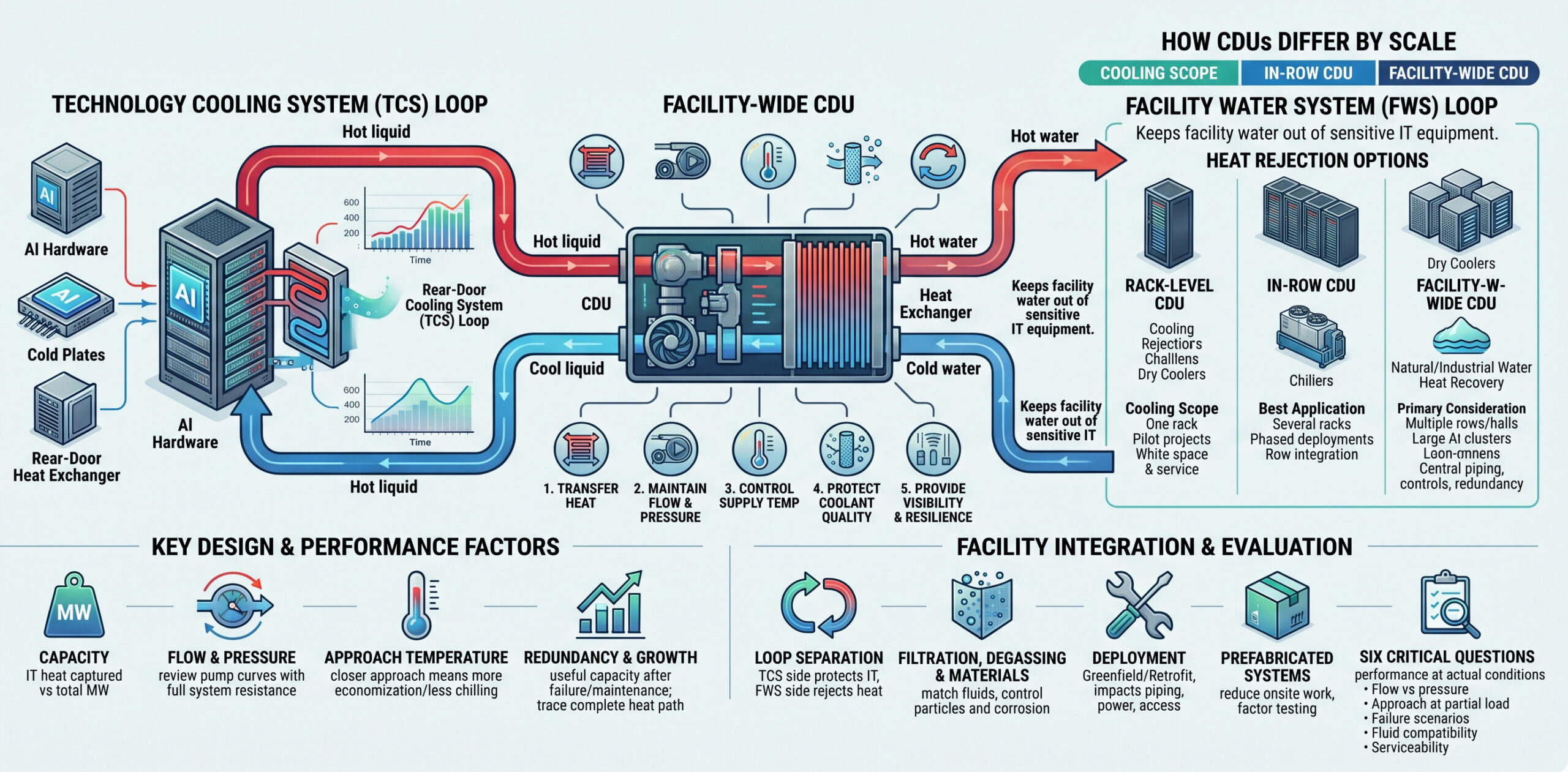
A facility-wide coolant distribution unit is a centralized liquid-cooling system that transfers heat from multiple AI racks, rows, or data halls to the facility’s heat-rejection infrastructure. It manages coolant temperature, flow, pressure, and quality while keeping the technology cooling system isolated from the facility water system.
The term describes the system’s scale and role. What changes is how much infrastructure the CDU serves and how deeply it integrates into the building.
Where Does the CDU Sit in the Cooling System?
The easiest way to understand the CDU is to follow the heat.
A cold plate, rear-door heat exchanger or immersion system transfers heat into the technology cooling system, often called the TCS. At the CDU, a heat exchanger moves it into the facility water system, or FWS. From there, it travels to the site’s heat-rejection system.
The CDU keeps facility water out of sensitive IT equipment while maintaining the technology loop at the conditions required by the servers.
What Does a Facility-Wide CDU Do?
At facility scale, the CDU has five core jobs:
- Transfer heat between the technology and facility loops. The heat exchanger keeps the fluids separate while moving heat efficiently.
- Maintain the required flow and pressure. Pumps move coolant through headers, branch piping, racks and cold plates.
- Control the coolant supply temperature. The CDU responds to changing IT loads and facility-water conditions.
- Protect coolant quality. Filtration, degassing and monitoring help control particles and trapped air.
- Provide visibility and resilience. Sensors, controls, alarms and redundant components help keep the system operating safely.
These functions also exist in smaller CDUs. At facility scale, however, a problem can affect far more equipment. That raises the standard for redundancy, serviceability and commissioning.
How Do Facility-Wide CDUs Differ From Rack and In-Row CDUs?
The difference is not just physical size. Each approach solves the cooling problem at a different point in the architecture.
| CDU Type | Cooling Scope | Best Application | Primary Consideration |
|---|---|---|---|
| Rack-level CDU | One rack or a small group | Pilot projects and isolated high-density racks | Capacity and service access within limited white space |
| In-row CDU | Several racks or one row | Phased deployments and high-density zones | White-space use, piping and growth within the row |
| Facility-wide CDU | Multiple rows, halls or zones | Large AI clusters and facility-scale liquid cooling | Central piping, redundancy, controls and heat-rejection integration |
These choices can coexist. A facility-wide CDU may be the main interface to the building while distribution equipment remains closer to the racks. The goal is to give each component a clear job. Every additional pump, valve and heat exchanger adds pressure loss, controls and maintenance, so the architecture should be as simple as the facility can safely operate.
Why Are AI Data Centers Moving Toward Facility-Wide CDUs?
AI Cooling Has Become a Facility-Level Problem
Operators have heard predictions about rising rack density for years. What is different now is the number of high-density systems being deployed together. AI is creating sustained, concentrated heat across entire clusters.
A collection of rack CDUs may work well for a trial. As the load grows, operators must manage more electrical feeds, controls, service points, and equipment in the white space. A facility-wide approach can centralize much of that work and allow cooling to be planned alongside the mechanical plant, rather than treating each AI deployment as an exception.
How Do Facility-Wide CDUs Support Mixed-Mode Cooling?
Most facilities will not transition from air to liquid in a single step. Existing equipment may remain air-cooled while newer systems use direct-to-chip, rear-door, or immersion cooling. Even direct-to-chip servers leave some residual heat for the room system.
A facility-wide CDU can provide a common thermal connection for several approaches when their coolant, temperature, flow and pressure requirements have been engineered correctly. Flexibility matters, but it is not unlimited compatibility. Server requirements must be reconciled during design, not after the equipment arrives.
How Is Facility-Wide CDU Capacity Calculated?
Megawatts are the easiest specification to compare. They are also one of the easiest to misunderstand.
- Start With the Facility’s Design Heat Load
Start with the IT heat that liquid will actually capture. A 20 MW AI hall does not necessarily send all 20 MW into the technology loop. The percentage depends on server architecture and residual heat left in the room.
Then account for deployment phases, design margin and future growth. Modular design can preserve the path to scale without buying years of unused capacity on day one.
The basic relationship is straightforward:
Heat removed = coolant flow × coolant heat capacity × temperature rise
In engineering terms, Q = ṁ × cp × ΔT. This is why a megawatt rating cannot stand alone. The same heat load can require very different flow depending on the coolant and permitted temperature rise.
- Why Are Flow and Pressure as Important as Megawatts?
The CDU must deliver the required flow after accounting for system resistance. Pipe dimensions, elevation, valves, filters, fittings, manifolds and cold plates all contribute to pressure loss.
A unit may have enough thermal capacity but still fall short at the calculated pressure head. Review performance curves at the intended operating point, not just the largest data-sheet number.
The goal is controlled equipment pressure with enough pumping capability to overcome real losses.
- How Does Approach Temperature Affect Performance?
Approach temperature describes how closely the CDU can bring technology-loop supply temperature to incoming facility-water temperature. A closer approach provides more useful cooling from the same facility water.
If servers can accept warmer coolant and the CDU operates with a close approach, the facility may gain economization hours and need less mechanical chilling. Chillers may provide trim capacity during the hottest conditions instead of carrying the full load all year.
Vendors may define approach at different measurement points, so the design team should confirm the temperatures and load conditions behind any published value.
- How Much Redundancy and Growth Capacity Is Needed?
Useful capacity is what remains after failure and maintenance scenarios are applied. In an N+1 design, the remaining equipment must carry the critical load when one module or pump is unavailable.
The same logic applies to filters, controls, power and heat rejection. Redundant pumps accomplish little if one upstream component can stop the system. Trace reliability through the complete heat path.
What Facility Design Factors Affect CDU Performance?
How Should the Technology and Facility Loops Be Separated?
The technology side protects IT equipment by controlling coolant quality, temperature and pressure. The facility side connects to the site’s heat-rejection resource.
A heat exchanger lets each side operate under appropriate conditions and limits the effect of facility-water contamination, pressure variation or treatment chemistry on the servers.
Which Heat-Rejection Systems Can a Facility-Wide CDU Support?
The CDU moves heat between loops. The facility still needs a practical way to reject or reuse it.
That may involve chillers, cooling towers, dry coolers, natural water, industrial water or heat recovery. A hybrid design might use dry cooling for much of the year and a smaller chiller during peak conditions.
Design the CDU and heat rejection together. As discussed in Nautilus’s guide to trim chilling, chillers may not need to carry the entire load when warmer liquid temperatures and other options are available.
Why Do Filtration, Degassing and Materials Matter?
Water-source agnostic does not mean chemistry agnostic. Materials, filtration and treatment must match the fluids on both sides of the CDU.
Particles can restrict passages, trapped gas can reduce pump performance, and incompatible materials can cause corrosion. These issues receive less attention than megawatt ratings, but often determine long-term performance.
Technicians must also be able to isolate and service pumps, filters, valves, sensors and heat exchangers without unnecessarily interrupting the critical load.
How Are Facility-Wide CDUs Deployed?
Greenfield projects provide more freedom, but still require early decisions. CDU placement affects pressure loss, electrical distribution, floor loading, drainage, controls and service access. Heat rejection affects water temperatures and CDU performance.
Mechanical, electrical, IT and operations teams must share the same assumptions. Late IT changes can create problems before the first rack is installed.
Can a Facility-Wide CDU Be Retrofitted Into an Existing Data Center?
Yes, but the building sets the rules. A retrofit may be constrained by mechanical space, pipe routes, electrical capacity, structural loading and the ability to connect to live systems.
The first deployment should anticipate buildout through larger headers, reserved connections or power and controls prepared for future modules. This avoids interrupting live infrastructure each time AI grows.
What Are the Benefits of Prefabricated CDU Systems?
Factory-built skids and containerized systems move more assembly and testing away from the active data center, reducing onsite fabrication and making schedules more predictable.
Prefabrication is not plug-and-play. Site piping, power, controls, flushing and commissioning still require coordination. Its value is completing more work under controlled factory conditions.
What Should Operators Evaluate Before Selecting a Facility-Wide CDU?
A good evaluation moves quickly past headline capacity. Operators and engineers should ask six practical questions:
- What capacity will the CDU deliver at our operating temperatures? Ask for performance at the planned TCS and FWS conditions, not only the vendor’s best rating point.
- Can it provide the required flow at the calculated pressure? Review pump curves after the full distribution system has been modeled.
- What approach temperature can it maintain at partial and full load? Confirm the measurement points and the effect on economization and chiller operation.
- What remains operational during maintenance or a failure? Trace redundancy across pumps, filters, controls, power, headers and heat rejection.
- Are the materials and coolant strategy compatible with the site? Confirm water sources, glycol, filtration, treatment and server requirements.
- How will the system be installed, commissioned and serviced? Evaluate factory testing, controls, spare parts, technician access and support.
The answers should describe an operating system, not isolated specifications. A CDU that cannot be maintained or expanded without interrupting the load is unlikely to be the right facility platform.
FAQ
What Is the Difference Between a Facility CDU and a Rack CDU?
A rack CDU serves one rack or a small group. A facility CDU transfers heat for multiple rows or halls and connects to the building’s heat-rejection infrastructure. The right choice depends on scale, operating conditions and maintenance strategy.
How Many AI Racks Can One Facility-Wide CDU Support?
There is no universal rack count. It depends on rack power, liquid heat-capture percentage, coolant temperatures, flow and redundancy. Designers should calculate the combined liquid heat load rather than rely on an average.
Can One Facility CDU Support Different Liquid-Cooling Technologies?
It can when their operating requirements are compatible or properly separated. Direct-to-chip, rear-door and immersion systems may connect to facility-scale infrastructure, but their temperature, pressure and fluid requirements must be addressed during design.
Does a Facility-Wide CDU Eliminate the Need for Chillers?
Not automatically. It depends on climate, coolant temperatures, approach temperature and heat rejection. One facility may use trim chilling while another still needs mechanical cooling for significant parts of the year.
Can Facility-Wide CDUs Be Added as AI Capacity Grows?
Yes, if headers, electrical systems, controls and heat rejection were designed for expansion. Modular CDUs cannot compensate for a distribution system with no remaining flow, pressure or connection capacity.


