
TL;DR – High-density AI racks push heat loads that air cooling can’t handle economically anymore. Water-cooled systems are now the default architecture for enterprise AI deployments, but providers aren’t interchangeable. When evaluating water-cooled data center providers, check approach temperature and how it converts to free cooling hours, water source flexibility, whether the cooling hardware can actually be serviced in the field, the manufacturing model behind lead times, and the operating pedigree of the team that built the system. A low PUE number on a spec sheet tells you nothing about how many hours a year that number actually holds. |
Why Air Cooling Stopped Being an Option
Data centers used to be built around one number: kilowatts per rack. That number climbed quietly for two decades. Then AI training clusters showed up and broke the curve entirely. A single GPU rack running dense training workloads can pull ten times the power of a standard enterprise rack from five years ago.
Air can’t move that much heat efficiently. Fans get louder, chillers get bigger, and the economics stop working. Direct-to-chip liquid cooling paired with a coolant distribution unit, or CDU, has become the standard architecture for high-density AI cooling
The question enterprise buyers face isn’t whether to move to water-cooled data centers. It’s which provider to trust with the system.
What a CDU Actually Does
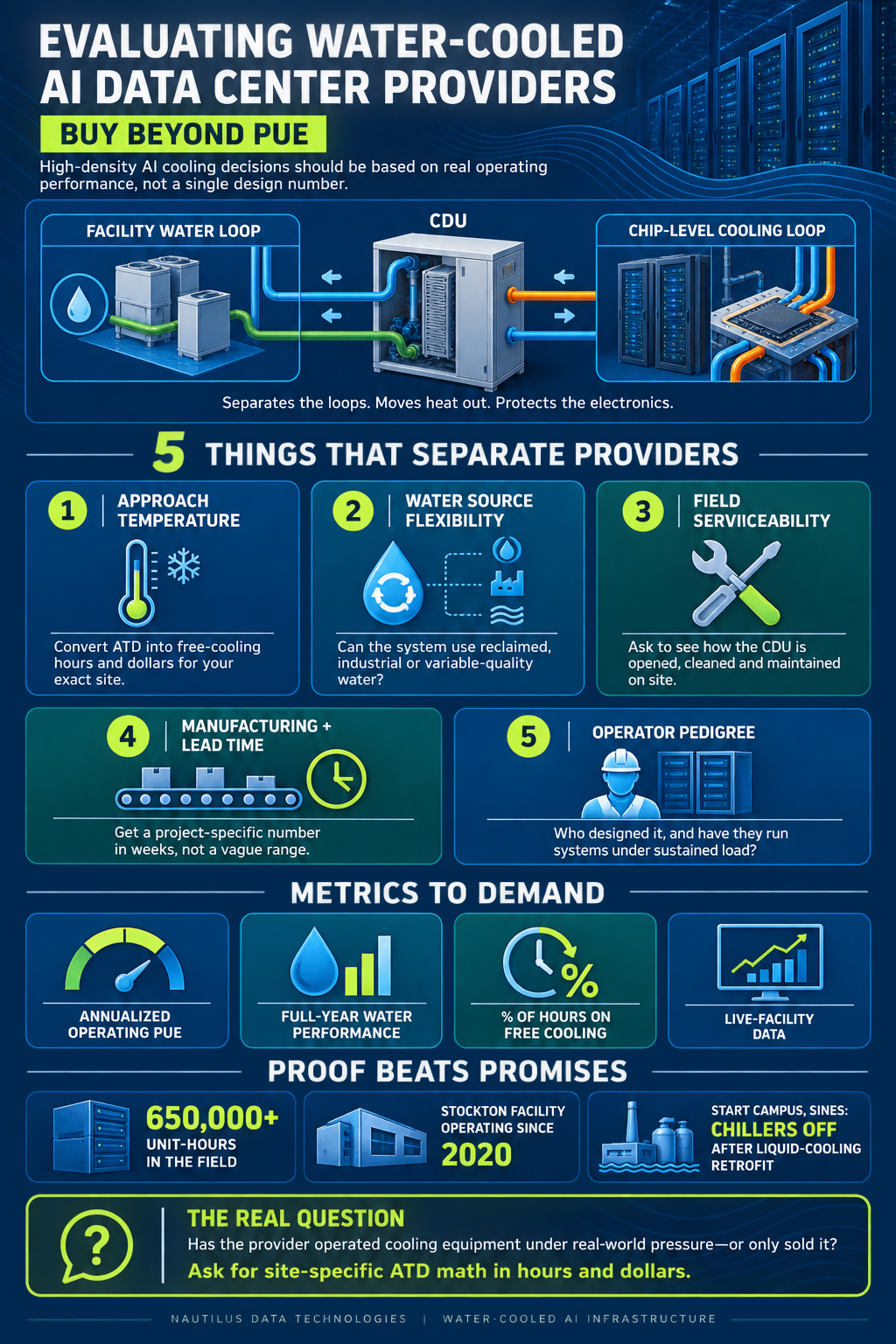
A CDU sits between the facility water loop and the chip-level cooling loop inside the server.
It pulls heat from the chips, keeps the two loops separate so facility water quality never touches the electronics, and rejects that heat to outside air, a cooling tower, or a body of water, depending on the site. Simple in concept. Hard to get right at scale, under real load, without downtime.
That’s where the differences between vendors start to show up.

Five Things That Actually Separate Providers
Every vendor in this space will hand you a PUE number and call the system efficient. That number is a starting point, not an answer. Here’s what to check instead.
- Approach temperature and what it means in hours. Approach temperature, or ATD, is the gap between outside air temperature and the point where a cooling system can still run in free cooling mode without mechanical assistance. A 2°C improvement in approach temperature looks small on a spec sheet. Nautilus’s FCD platform is built around holding that tighter approach, and in a market like Ashburn, Virginia, 2°C can translate into hundreds of additional hours per year running on free cooling instead of chillers. Ask any provider to convert their ATD number into hours and dollars for your specific site. If they can’t, that tells you something too.
- Water source flexibility. Some cooling architectures are locked to a specific water quality or source. Others are engineered to run on variable or lower-quality water without added treatment infrastructure. For land-based data center campuses being sited near industrial, reclaimed, or non-potable water, this flexibility changes what land is viable and what permitting looks like.
- Serviceability of the CDU itself. Heat exchangers foul over time no matter who builds them. The difference is whether the unit is designed to be opened, cleaned, and maintained in the field, or whether it’s a sealed assembly that gets swapped out once performance degrades. Ask to see the actual maintenance procedure, not just the spec sheet.
- Manufacturing model and lead time. A provider that owns its own factories is betting on one supply chain and one set of components. A provider that builds to spec across contract manufacturers can usually adapt faster when a component goes on allocation, and quote shorter lead times as a result. Nautilus builds this way on purpose, sourcing components across manufacturers so a single factory’s queue never becomes the bottleneck. Get a real number in weeks, not a range.
- Operator pedigree. Ask who designed the system and what they did before this. Engineers who spent years running thermal operations at scale design differently than engineers who’ve only ever sold equipment. It shows up in small decisions: how leaks are prevented, how failures get detected, how the system behaves when a valve sticks at 2 a.m.
Sustainability Metrics Worth Tracking
Sustainable data center infrastructure gets talked about in generalities. Buyers need specifics. Ask for the actual PUE the facility achieves annualized, not the design PUE claimed at commissioning.
Ask how water-efficient cooling systems are measured at that site across a full year of seasonal variation, not one summer data point. What percentage of annual hours the site runs on free cooling versus mechanical cooling matters too, since that number drives both the sustainability story and the operating cost. And don’t accept a vendor’s self-reported figures without a live facility to point to.
None of these numbers mean much in isolation. A provider who can show real performance data from an operating facility, not a simulation, is worth more than one with a sharper slide deck.
Proof Beats Promises
Start Campus in Sines, Portugal is a useful case study here.
The facility was originally built with a chiller and fan-wall design that couldn’t keep up once AI workloads moved in. After retrofitting with liquid cooling, the site reached a point where it could reject heat to the ocean in real time with zero downtime, and the operator turned off its chillers entirely. That’s the kind of proof point worth asking every provider for: a real site, with a name attached, running real workloads over time.
Nautilus built our first-of-a-kind facility in Stockton, California, back in 2020, and it’s been running paying customer workloads ever since.
Every generation of CDU since has been shaped by what that facility taught us about failure modes, maintenance cycles, and what actually breaks under sustained load. Our flagship CDU line carries NVIDIA’s AI Factory Infrastructure Partner designation, and our systems have logged more than 650,000 unit-hours in the field.
Sustainability Metrics Worth Tracking
Strip away the marketing and it comes down to one question: has this provider run cooling equipment under real operational pressure, or have they only sold it? Enterprise data center providers who’ve operated facilities themselves tend to design for the failure that happens at 2 a.m. on a holiday weekend, not just the demo that happens in a showroom.
If you’re evaluating water-cooled data center providers for an AI deployment, start by asking for real operating data from a real site. Then ask how their approach temperature turns into hours and dollars at your location. Talk to our engineering team if you want us to run that math for your site.
FAQ
What is a water-cooled data center?
A water-cooled data center uses liquid, moved through a coolant distribution unit or CDU, to remove heat directly from server components instead of relying on air alone. It’s the standard architecture now used for high-density AI training and inference workloads.
Why do AI data centers need water cooling instead of air cooling?
AI training racks generate far more heat per square foot than standard enterprise racks. Air cooling becomes inefficient and expensive at that density, while liquid cooling paired with a CDU can move the same heat load with a much smaller mechanical footprint.
What is approach temperature (ATD) and why does it matter?
Approach temperature is the difference between outside air temperature and the point where a cooling system can still operate in free cooling mode without chillers. A lower ATD means more hours per year running on free cooling, which lowers both energy use and operating cost.
How do I evaluate a water-cooled cooling provider?
Look at approach temperature and how it converts to free cooling hours at your site, water source flexibility, whether the CDU can be serviced and cleaned in the field, the manufacturing model behind lead times, and the operational background of the engineering team.
Can water-cooled cooling systems run on any water source?
It depends on the architecture. Some CDUs require a specific, closely controlled water source. Others are engineered to run on variable water quality, which matters for land-based data center campuses sited near industrial or reclaimed water.
How long does it take to deploy a water-cooled cooling system?
Lead times vary widely by provider and manufacturing model. Ask for a specific number in weeks tied to your project, not an industry average, since supply chain flexibility affects this more than most buyers expect.
What PUE should I expect from a water-cooled AI facility?
PUE depends on climate, water source, and system design. Ask for the annualized operating PUE from a live facility rather than a design target, since seasonal variation can significantly affect the number.


