
TL;DR: AI growth is making data center cooling needs harder to predict. Instead of building rigid infrastructure that quickly becomes outdated, operators are adopting modular liquid cooling strategies that can scale gradually alongside AI demand. Flexibility, scalability, and phased deployment planning are becoming critical for modern AI infrastructure.
Why Flexible Liquid Cooling Infrastructure Is Now Critical for AI Growth
AI infrastructure planning has changed fast. Faster than most operators expected.
Just a few years ago, many data centers were still debating whether liquid cooling would ever become mainstream. Today, the conversation looks very different. AI workloads are pushing rack densities higher every quarter. GPU clusters continue to expand. Power requirements are climbing. Cooling demands are following right behind them.
And here is the challenge many operators are now facing.
How do you build a liquid cooling strategy when nobody really knows how large AI deployments will become over the next three to five years?
That uncertainty is shaping nearly every major infrastructure decision in the industry right now.
Some operators are worried about overbuilding. Others are worried about falling behind. Many are retrofitting liquid cooling into existing facilities while preserving flexibility for future growth.
Does that sound familiar?
If so, you are not alone.
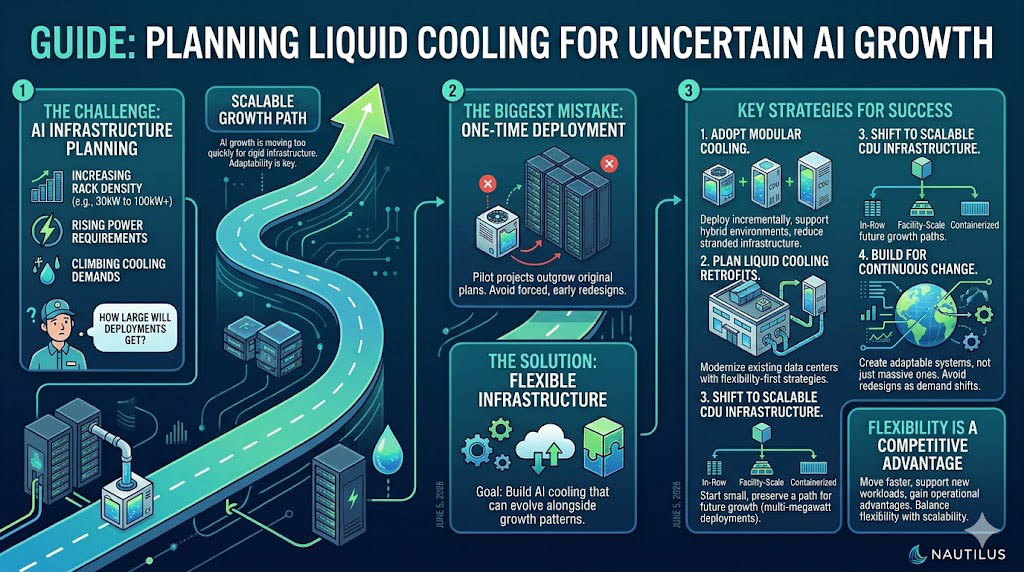
The reality is that AI infrastructure growth rarely follows a straight line. What begins as a small pilot project can quickly evolve into a large-scale AI deployment that demands significantly more cooling capacity, power distribution, and infrastructure planning than originally expected.
That is why flexible liquid-cooling infrastructure has become one of the most important topics in modern data center design.
AI Growth Is Moving Faster Than Traditional Infrastructure Planning
Traditional data center expansion cycles were often predictable. Operators could forecast demand years in advance and scale gradually.
AI has disrupted that model.
Today, organizations are deploying high-density cooling environments much faster than previous generations of infrastructure. New GPU platforms are increasing thermal output. AI training clusters are consuming enormous amounts of power. Enterprise AI adoption is accelerating across nearly every industry.
At the same time, many organizations still do not fully know:
- How many AI racks will they need
- What future rack densities will look like
- How quickly will workloads scale
- Which cooling technologies will dominate long-term
That creates a difficult planning environment.
No operator wants to invest heavily in infrastructure that becomes outdated too quickly. But waiting too long to deploy liquid cooling for AI data centers can create operational bottlenecks that slow growth and limit competitiveness.
This is why scalable liquid cooling strategies are becoming essential.
The goal is no longer simply deploying cooling infrastructure for today’s workloads. The goal is to build an AI cooling infrastructure that can evolve alongside uncertain growth patterns.
Why Traditional Data Center Cooling Planning No Longer Works
Have you ever noticed how quickly AI changes hardware?
One year a facility may support 30 kW racks comfortably. A short time later, new deployments may require 80 kW, 100 kW, or even higher densities.
That creates significant pressure on legacy air-cooling systems.
Many traditional facilities were never designed to support modern AI rack cooling requirements. Operators are now facing difficult questions around:
- Cooling infrastructure planning
- White space utilization
- Chilled water integration
- Future expansion capacity
- Deployment timelines
- Retrofit constraints
This is where liquid cooling retrofits are becoming increasingly important.
Instead of rebuilding entire facilities, many organizations are exploring modular liquid-cooling approaches that enable incremental scaling.
That flexibility matters more than ever.
The Biggest Mistake Operators Make
One of the most common mistakes in AI infrastructure scaling is treating liquid cooling like a one-time deployment.
It rarely works that way.
Many organizations begin with a small AI cluster. They deploy a few liquid-cooled racks. Maybe they support a pilot workload or a new GPU environment.
Then demand grows.
More tenants request AI infrastructure. More computing capacity is required. Rack densities increase again. Suddenly, the original cooling strategy no longer fits the operational reality.
Now the organization is forced to redesign portions of its infrastructure earlier than expected.
This happens constantly across the industry.
The better approach is to plan liquid cooling infrastructure in phases.
That means designing a strategy that supports:
- Immediate deployment needs
- Future AI workload growth
- Evolving cooling technologies
- Changing density requirements
- Gradual facility expansion
The most effective AI cooling solutions are flexible enough to scale without causing major operational disruption whenever workloads evolve.
Why Modular Liquid Cooling Matters
Modular infrastructure is becoming a defining trend in AI data center cooling.
Why?
Because uncertainty has become the norm.
Many operators no longer want rigid infrastructure that locks them into a fixed deployment model. They want a scalable CDU infrastructure that allows them to grow gradually while preserving flexibility.
This is where modular cooling platforms become valuable.
A modular approach allows operators to:
- Deploy liquid cooling incrementally
- Support hybrid cooling environments
- Scale cooling capacity over time
- Reduce stranded infrastructure
- Preserve white space
- Simplify future expansion planning
Does that make sense?
Instead of building for maximum theoretical demand on day one, operators can scale cooling infrastructure alongside real-world AI growth.
That creates a much more sustainable deployment strategy.
Data Center Liquid Cooling Retrofits Are Becoming the New Normal
For many organizations, building a brand-new AI facility is not realistic.
Retrofitting liquid cooling into existing data centers is becoming far more common.
Enterprise operators, colocation providers, cloud environments, and edge deployments are all seeking ways to modernize existing infrastructure without causing massive operational disruption.
This trend is accelerating rapidly.
Many existing facilities still have valuable power infrastructure, network connectivity, and physical capacity. The challenge is enabling those environments to support modern AI workload cooling demands.
That is where liquid cooling retrofit strategies become critical.
The most successful retrofit projects focus on flexibility first.
Operators need cooling infrastructure that can:
- Integrate into existing environments
- Support phased deployments
- Expand as AI demand grows
- Minimize downtime
- Preserve operational continuity
This is one reason modular CDU systems are attracting so much attention throughout the market.
The Shift Toward Scalable CDU Infrastructure
Cooling Distribution Units are becoming central to modern AI cooling infrastructure planning.
But not every deployment requires the same approach.
Some facilities may only need localized cooling support for a small number of AI racks. Others may require facility-scale liquid cooling capable of supporting multi-megawatt deployments.
This is why scalable CDU infrastructure matters.
Flexible platforms allow operators to start small while preserving a path toward future growth.
For example:
- In-row deployments may support early-stage AI rollouts
- Facility-scale cooling systems may support expanding AI halls
- Containerized cooling platforms may support hyperscale growth
The important thing is not simply choosing a cooling system.
The important thing is choosing a cooling strategy that can evolve over time.
AI Cooling Infrastructure Must Support Continuous Change
One of the biggest realities in the AI market is that nobody truly knows what workloads will look like three years from now.
GPU architectures are evolving quickly. AI models continue to grow larger. Cooling requirements are shifting constantly.
This uncertainty is reshaping how operators think about infrastructure planning.
Instead of asking:
“What cooling system do we need today?”
Operators are increasingly asking:
“How do we avoid redesigning our infrastructure every time AI demand changes?”
That is a much smarter question.
Future-proof data center cooling is no longer about building the largest system possible. It is about creating an adaptable infrastructure that can respond to changing requirements without excessive disruption.
That is a major difference.
Why Data Center High-Density Cooling Is Becoming Standard
Not long ago, high-density cooling environments were considered specialized deployments.
Now they are becoming increasingly common.
AI workloads are driving rapid adoption of:
- Direct-to-chip cooling
- Liquid cooling for GPU servers
- Hybrid cooling architectures
- High-density rack deployments
- Advanced thermal management systems
Many facilities are already planning for higher long-term density assumptions because AI growth shows no signs of slowing.
At the same time, operators still need deployment flexibility.
That balance between scalability and flexibility is shaping the future of liquid cooling deployment strategies.
Planning for Uncertain AI Growth Requires a Different Mindset
This is where many organizations struggle.
Traditional infrastructure planning focused heavily on predictability. AI infrastructure planning requires adaptability.
The organizations succeeding right now are building liquid-cooling solutions for data centers that can evolve gradually rather than forcing large-scale redesigns every few years.
That means:
- planning for phased growth
- supporting hybrid environments
- preserving future deployment options
- reducing operational disruption
- prioritizing modular scalability
The smartest operators understand that uncertainty itself has become part of the infrastructure equation.
Why Flexibility Is Becoming a Competitive Advantage
AI deployment speed matters.
Organizations that can scale AI infrastructure quickly often gain significant operational advantages. They can support new workloads faster, onboard customers more efficiently, and adapt to market changes more easily.
Cooling infrastructure plays a major role in that flexibility.
Rigid cooling systems can slow expansion timelines. Limited scalability can create deployment bottlenecks. Overbuilt infrastructure can waste capital.
Flexible liquid cooling infrastructure helps operators move faster without sacrificing long-term scalability.
That is becoming increasingly valuable as AI adoption accelerates across industries.
The Data Center Industry Is Moving Toward Hybrid Cooling Environments
Another major trend shaping AI data center cooling is the rise of hybrid environments.
Very few facilities are transitioning from traditional air cooling to full liquid cooling overnight.
Most deployments are happening gradually.
A facility may support:
- Traditional enterprise workloads
- High-density AI clusters
- GPU training environments
- Mixed cooling architectures
- Phased modernization projects
This is why flexible cooling infrastructure matters so much.
Operators need systems that can support multiple deployment models simultaneously while leaving room for future growth.
That is not easy. But it is becoming increasingly necessary.
The Future of AI Data Center Cooling Infrastructure
The future of AI infrastructure scaling will likely look very different from traditional data center growth models.
Cooling infrastructure will become more modular. More scalable. More adaptive.
Operators will continue prioritizing:
- Scalable liquid cooling
- Modular deployment strategies
- High-density cooling support
- Retrofit flexibility
- Facility-scale liquid cooling
- Future-proof infrastructure planning
At the same time, uncertainty around AI demand will remain.
That uncertainty is not going away anytime soon.
And honestly, that may be the most important point of all.
The organizations that succeed in the next generation of AI infrastructure will not necessarily be the ones with the largest facilities today.
They will be the ones with the flexibility to adapt tomorrow.
Final Thoughts
Planning data center liquid cooling for uncertain AI growth is ultimately about balancing flexibility with scalability.
Operators need infrastructure that supports today’s workloads without limiting tomorrow’s opportunities.
That requires a different approach to cooling infrastructure planning.
Instead of focusing only on immediate deployment requirements, organizations must think about:
- Long-term scalability
- Phased AI growth
- Evolving density requirements
- Modular cooling strategies
- Operational flexibility
- Future expansion potential
AI growth is moving too quickly for rigid infrastructure models.
The future belongs to adaptable liquid-cooling infrastructure that can scale from small AI deployments to large, facility-wide environments without requiring constant redesigns.
Because in the AI era, flexibility is no longer optional.
It is an infrastructure strategy.
AI infrastructure is evolving too quickly for rigid cooling strategies. The operators that stay ahead will be the ones that can scale efficiently, adapt quickly, and deploy liquid cooling without constant redesigns.
Whether you are planning a retrofit, expanding AI capacity, or preparing for higher-density workloads, flexible liquid cooling infrastructure can help future-proof your data center for long-term growth.
Ready to build a smarter AI cooling strategy? Contact Nautilus to learn how scalable liquid cooling solutions can support your next phase of AI infrastructure expansion.
FAQ
Why is liquid cooling becoming important for AI data centers?
AI workloads generate significantly more heat than traditional computing environments. As GPU densities continue rising, many facilities can no longer rely on air cooling alone. Liquid cooling helps manage high-density AI infrastructure more efficiently while supporting better thermal performance, scalability, and long-term growth planning.
What is the biggest challenge when planning AI cooling infrastructure?
One of the biggest challenges is uncertainty. Many operators do not know how quickly AI workloads will grow, what future rack densities will require, or how cooling technologies will evolve. This makes flexible and modular liquid cooling strategies increasingly important for long-term infrastructure planning.
Can existing data centers be retrofitted for liquid cooling?
Yes. Many organizations are retrofitting existing facilities with liquid cooling infrastructure instead of building entirely new AI data centers. Modular retrofit strategies allow operators to modernize cooling systems gradually while minimizing downtime and preserving existing infrastructure investments.
What role do CDUs play in AI liquid cooling?
Cooling Distribution Units (CDUs) help transfer and regulate coolant throughout liquid cooling systems. They are a central component in many AI cooling deployments because they support scalable cooling capacity, phased expansion, and flexible infrastructure growth as AI workloads increase.
Why are modular liquid cooling systems gaining popularity?
Modular liquid cooling systems allow operators to scale infrastructure incrementally instead of overbuilding on day one. This approach helps reduce stranded capacity, supports hybrid cooling environments, simplifies future expansion, and gives organizations greater flexibility as AI demand continues evolving.
