
TL;DR:
As AI drives higher GPU densities, traditional air cooling is reaching its limits. Liquid cooling is becoming essential, and CDUs are emerging as critical infrastructure because they manage coolant flow, temperature, and pressure, helping data centers scale AI workloads reliably and efficiently.
For years, cooling infrastructure was largely an afterthought in data center conversations.
Servers got the attention. Processors got the headlines. Networking equipment drove infrastructure decisions. Cooling systems quietly did their job in the background.
Then AI happened.
Today, data centers are deploying racks filled with power-hungry GPUs capable of supporting large language models, generative AI applications, and advanced machine learning workloads. As GPU density increases, organizations are discovering that the challenge isn’t simply adding more compute power.
It’s removing the heat that comes with it.
Most discussions about AI infrastructure focus on GPUs. That’s understandable. They’re the engines driving the AI revolution.
But another story is unfolding behind the scenes.
As rack densities continue to rise, coolant distribution units (CDUs) are emerging as one of the most important pieces of infrastructure inside modern AI data centers.
The future of AI isn’t just about more GPUs.
It’s about the infrastructure required to keep them running.
AI Is Pushing Rack Density Into Uncharted Territory
The challenge is straightforward. As GPU density increases, heat output rises alongside it. Eventually, operators reach a point where simply moving more air is no longer practical.
That’s why liquid cooling is becoming a core requirement for next-generation AI infrastructure. In fact, many data center operators are seeing growing demand for liquid-cooled environments as AI tenants seek the power density and cooling performance needed to support modern GPU deployments.
Why Liquid Cooling Requires a New Infrastructure Layer
When people talk about liquid cooling, the conversation often centers on cold plates, coolant loops, and direct-to-chip cooling technologies.
Those components are important. They are the parts of the system most operators see and interact with on a daily basis.
But deploying liquid cooling at scale requires far more than moving coolant through a server. It requires an entirely new layer of infrastructure designed to manage, monitor, and optimize the cooling environment.
Think of it this way: adding liquid cooling without a CDU is like installing plumbing throughout a building without a system to manage the water supply. The pipes may be in place, but something still needs to regulate flow, maintain temperature, control pressure, and ensure reliable operation.
That’s the role of the coolant distribution unit. The CDU serves as the operational hub of a liquid cooling system, providing the control and reliability needed to support high-density computing environments.
What Is a CDU and Why Does It Matter?
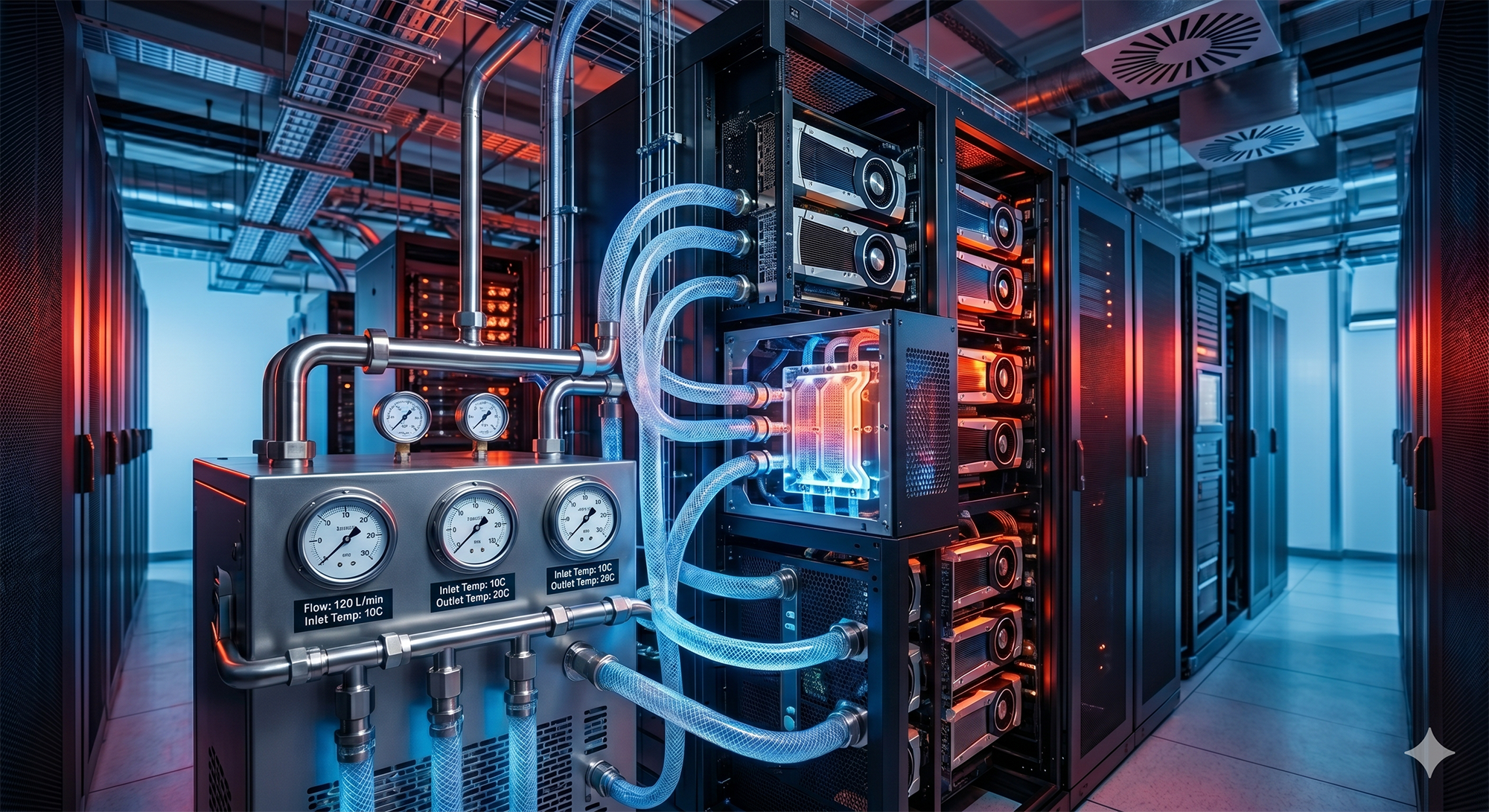
A coolant distribution unit (CDU) is the operational hub of a liquid cooling system. It removes heat from IT equipment while managing coolant temperature, flow, and pressure throughout the cooling loop.
CDUs play a critical role in maintaining reliable cooling performance by:
- Maintaining consistent coolant temperatures
- Regulating coolant flow rates
- Managing pressure across the cooling loop
- Protecting sensitive IT equipment
- Supporting scalable, high-density cooling deployments
Without a CDU, operating a large-scale liquid cooling environment becomes significantly more complex and difficult to manage.
As AI workloads drive rack densities higher, CDUs are evolving from supporting infrastructure into a foundational component of modern data center design. They provide the control, reliability, and scalability required to cool today’s high-performance computing and AI environments.

GPU Density Is Driving CDU Adoption
Many organizations are beginning to recognize the same trend: as GPU power requirements increase, cooling demands don’t rise in a straight line. They accelerate.
Each new generation of AI hardware generates more heat than the last. Operators aren’t simply adding more servers. They’re packing more compute power into fewer racks, driving power densities to levels that traditional cooling systems were never designed to support. Recent independent testing of Nautilus’ EcoCore Facility Cooling Distribution (FCD) platform demonstrated performance exceeding 4.1 MW of cooling capacity while supporting flow rates and pressure requirements aligned with next-generation AI GPU deployments, highlighting how cooling infrastructure is evolving to meet future AI demands.
That concentration creates several challenges:
- Higher heat loads per rack
- Greater demand for thermal stability
- More complex cooling architectures
- Stricter reliability requirements
- Increased pressure on facility infrastructure
CDUs help address these challenges by creating a controlled interface between facility cooling systems and high-density liquid-cooled IT equipment. They regulate temperature, flow, and pressure while ensuring cooling performance remains consistent as workloads scale.
As AI infrastructure continues to evolve, that role becomes increasingly critical. The higher rack densities climb, the more important CDU technology becomes to maintaining reliable, efficient operations.
Why AI Data Centers Need Scalable Cooling Infrastructure
One of the biggest mistakes organizations can make is treating AI cooling as a one-time infrastructure project.
GPU density isn’t slowing down. If anything, it’s accelerating. The cooling systems deployed today may need to support significantly higher thermal loads within just a few years.
That’s why scalability has become a critical consideration when designing and deploying liquid cooling infrastructure.
Operators are increasingly asking questions such as:
- Can the cooling system support future GPU generations?
- How easily can cooling capacity be expanded?
- Will the infrastructure support higher rack densities over time?
- Can the facility adapt without major redesigns or costly upgrades?
These aren’t just engineering questions. They’re business questions.
The answers shape capital investment decisions, influence deployment timelines, and determine how effectively an organization can scale its AI infrastructure in the years ahead.
As AI workloads continue to evolve, the most successful cooling strategies will be those designed not only for today’s requirements, but for the demands that are still on the horizon.
The Future of AI Infrastructure Depends on Cooling Infrastructure
For decades, data center planning centered on three primary considerations: power, space, and connectivity.
Cooling was always important, but it was rarely the factor that determined how far infrastructure could scale.
AI is changing that reality.
Today, the ability to deploy high-density GPU environments increasingly depends on efficient cooling. In many cases, cooling capacity has become just as important as power availability when planning for growth.
As a result, cooling infrastructure is evolving from a support system into a strategic asset. Organizations can no longer view cooling as an afterthought. It has become a foundational requirement for scaling AI workloads.
At the heart of many liquid-cooling architectures is the coolant distribution unit (CDU), which provides the control, reliability, and scalability needed to support high-density computing environments.
As AI workloads continue to grow, organizations that invest in scalable cooling infrastructure today will be better positioned to support future generations of hardware while maintaining performance, reliability, and operational efficiency.
The Next Evolution: From Cooling Component to Infrastructure Platform
The conversation around CDUs is evolving.
Just a few years ago, many organizations viewed coolant distribution units as supporting components within a liquid cooling system. Today, that perspective is beginning to change.
As AI deployments grow in size and complexity, CDUs are evolving from individual cooling components into critical infrastructure platforms that help manage thermal performance across entire environments.
Consider what happens when an organization scales from a handful of liquid-cooled racks to hundreds. Cooling is no longer a standalone system. It becomes a network of interconnected assets that must operate reliably around the clock.
At that scale, visibility, monitoring, redundancy, and scalability become just as important as the ability to remove heat.
In many ways, the shift mirrors the evolution of power infrastructure. Power distribution units were once viewed as basic supporting equipment. Today, they are essential to modern data center operations, providing the reliability and control required to support critical workloads.
CDUs appear to be following a similar path. As AI workloads continue to drive higher rack densities, the systems that manage cooling infrastructure will play an increasingly important role in overall facility performance, efficiency, and resilience.
Why This Matters for Data Center Operators
For organizations planning AI infrastructure, the implications are significant.
The cooling decisions made today will influence data center performance, scalability, and operational flexibility for years to come.
When evaluating liquid cooling strategies, organizations should consider:
- Current and future rack density requirements
- Projected growth of AI workloads
- Cooling infrastructure scalability
- Facility water and thermal management capabilities
- Long-term efficiency and sustainability goals
The objective is not simply to deploy enough cooling capacity for today’s workloads. It’s to build an infrastructure foundation capable of supporting future generations of AI hardware as power densities continue to rise.
Organizations that take a long-term approach to cooling infrastructure will be better positioned to scale AI deployments, accelerate time to deployment, and avoid the costly limitations that can emerge when cooling becomes a bottleneck.
Conclusion: The Rise of the CDU Era
The AI conversation often centers on GPUs, processors, and compute performance. Those technologies deserve the attention they receive.
But behind every successful AI deployment is an infrastructure foundation capable of supporting it, and cooling has become one of the most critical pieces of that foundation.
As rack densities continue to rise and traditional air-cooling approaches approach their practical limits, liquid cooling is becoming essential for supporting next-generation AI workloads. In turn, CDUs are emerging as a critical component of modern AI infrastructure, providing the control, reliability, and scalability required to manage increasingly complex cooling environments.
In many ways, the future of AI infrastructure is no longer defined solely by compute power. It’s also defined by the ability to remove the heat that computing generates.
Organizations that recognize this shift early and invest in scalable cooling infrastructure will be better positioned to support future generations of AI hardware, accelerate deployment timelines, and maintain a competitive advantage as data center demands continue to evolve.
As AI workloads continue to grow, cooling infrastructure is becoming a strategic factor in data center performance, scalability, and long-term success. Whether you’re planning your first liquid cooling deployment or preparing for the next generation of high-density GPU environments, having the right infrastructure in place is critical. Learn how Nautilus Data Technologies’ CDU solutions can help you build a more efficient, scalable, and AI-ready data center. Contact our team to discuss your cooling requirements and future infrastructure goals.
FAQ
Why is GPU density increasing in AI data centers?
GPU density is increasing because organizations need more computing power to support AI training, inference, and other high-performance workloads. Rather than expanding facility footprints, many operators are deploying more GPUs within the same rack space. This approach improves efficiency but also creates greater heat loads, making cooling infrastructure a critical part of modern AI data center design.
Why are CDUs important for AI data center cooling?
A coolant distribution unit (CDU) helps manage the flow, temperature, and pressure of coolant in a liquid-cooling system. As AI data center cooling requirements grow, CDUs provide the control and reliability needed to support high-density GPU environments. They serve as a critical connection between facility cooling systems and liquid-cooled IT equipment.
At what point do AI workloads require liquid cooling?
There is no universal threshold, but many organizations begin evaluating liquid cooling as rack densities move beyond what traditional air cooling can efficiently support. As high-density workloads become more common and GPU power consumption increases, liquid cooling for AI often becomes necessary to maintain performance, reliability, and energy efficiency.
How does GPU density affect data center scaling?
Higher GPU density allows organizations to deploy more computing power within the same physical footprint, but it also increases demands on power, cooling, and facility infrastructure. Successful AI data center scaling requires careful planning around cooling capacity, data center power and cooling systems, and long-term infrastructure growth to avoid future bottlenecks.
What should organizations consider when planning AI-ready data centers?
Organizations should evaluate rack density goals, cooling requirements, power availability, scalability, and future hardware roadmaps. Effective AI infrastructure planning also includes assessing liquid cooling strategies, CDU requirements, data center capacity planning, and the overall architecture needed to support next-generation AI workloads.
