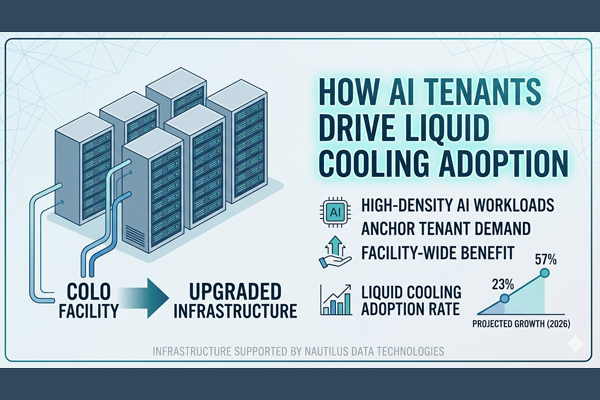
TL;DR: AI workloads generate enormous amounts of heat, and traditional air cooling often wastes that energy. Modern liquid cooling systems can capture and transfer waste heat for reuse in applications such as district heating, industrial processes, and building energy systems. By turning excess heat into a usable resource, data centers can improve energy efficiency, reduce environmental impact, lower cooling strain, and create more sustainable AI infrastructure.
Walk into a traditional data center, and you’ll notice two things almost immediately.
First, the sound. A constant roar of fans pushing hot air around like a giant metallic wind tunnel.
Second, the heat.
Not cozy fireplace heat, either. More like “why does this room feel like the back of a restaurant kitchen?” kind of heat.
A few years ago, we toured a facility packed with high-performance servers, and remembered standing near one row of equipment thinking, This place could probably heat a small neighborhood. At the time, that sounded ridiculous. Today? It’s becoming a reality.
As AI continues to explode and companies race to build larger, more powerful systems, the conversation around cooling has changed dramatically. We’re no longer just talking about keeping servers from overheating. We’re talking about something much bigger:
How to capture reusable heat from data centers and turn it into something useful.
And honestly, it’s one of the most interesting shifts happening in technology right now.
AI systems consume massive amounts of power. That power creates heat. Tons of it. Instead of wasting all that thermal energy, newer facilities are beginning to reuse it for buildings, industrial processes, and even district heating from data centers.
That’s where liquid cooling heat recovery comes into play.
And weirdly enough, the future of AI infrastructure sustainability might look less like a cold server room and more like a modern energy plant.
Why AI Creates So Much Data Center Heat
AI workloads are different from traditional computing tasks.
Streaming a movie, loading a webpage, or checking email doesn’t require huge bursts of processing power. Training AI models does. Especially modern models running on dense clusters of GPUs.
Think of GPUs like athletes sprinting nonstop during a marathon while carrying dumbbells. They’re doing an insane amount of work every second.
All that effort generates heat.
A lot of it.
Older data centers relied mostly on air cooling. Giant fans pushed cool air through server racks while hot air got exhausted out of the building. It worked for years because servers weren’t nearly as power hungry as they are today.
But high-density AI cooling changes the equation.
Some AI racks now exceed 50kW, 80kW, or even 100kW per rack. At those levels, air cooling starts struggling. It’s like trying to cool a bonfire with a desk fan.
That’s why the industry is rapidly shifting toward sustainable liquid-cooling for data centers.
Instead of relying entirely on air, liquid cooling moves coolant directly near the chips where heat is generated. Liquids absorb heat far more efficiently than air, which makes the entire process dramatically more effective.
And here’s the important part:
Once that heat is captured in liquid form, it becomes much easier to reuse.
That’s the breakthrough.
What Is Data Center Liquid Cooling Heat Recovery?
At its simplest, liquid-cooling heat recovery means capturing the heat removed from AI servers and redirecting it to a useful purpose rather than letting it go to waste.
Pretty straightforward, right?
Imagine boiling water on your stove. The pot gets hot because it absorbs energy. Now imagine taking that hot water and piping it somewhere else to warm another room.
That’s essentially what happens inside advanced liquid-cooled data centers.
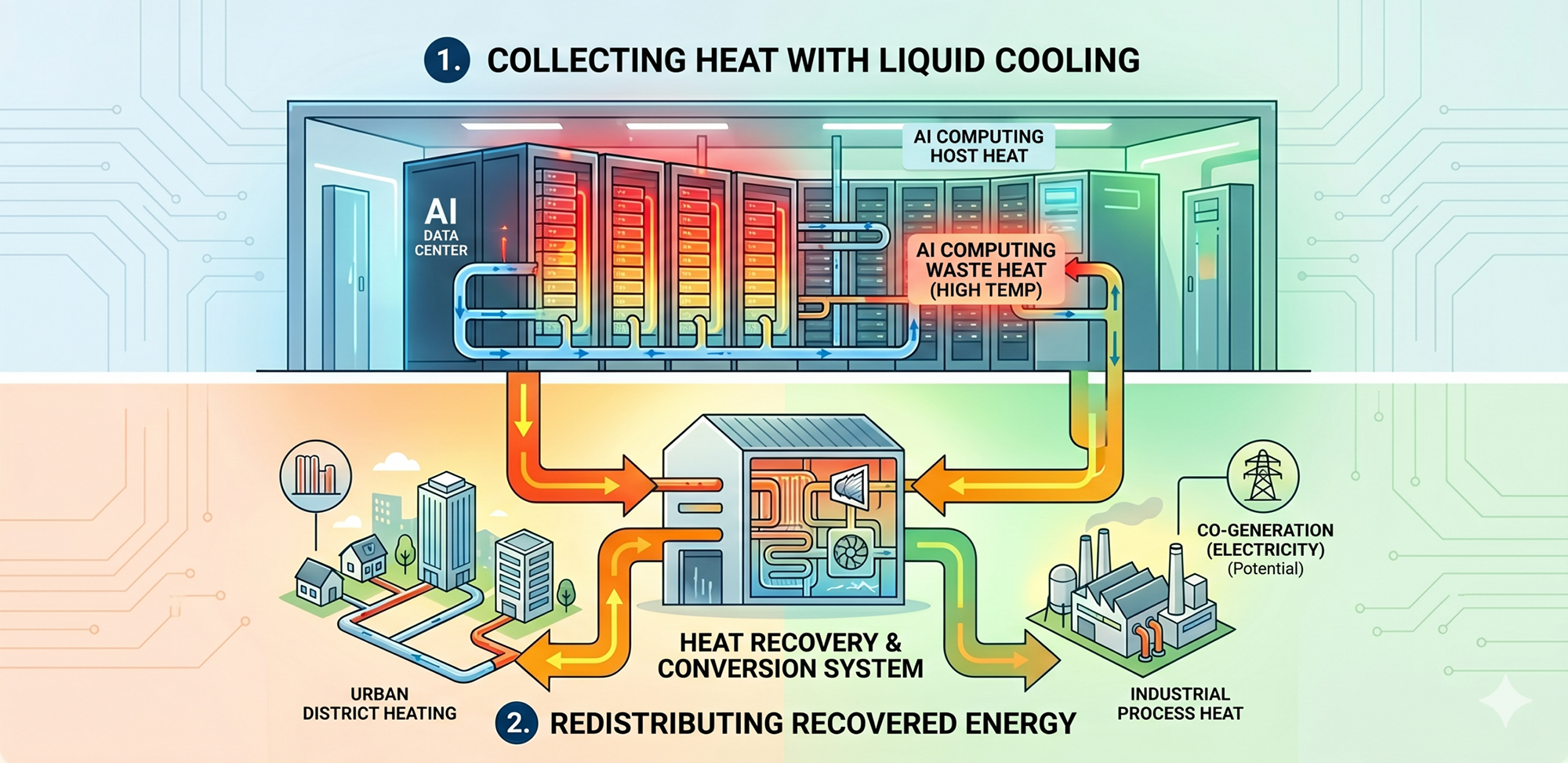
The cooling liquid absorbs heat from servers and carries it away through a closed-loop system. Instead of dumping that heat outside, facilities can transfer it to:
- Office buildings
- Apartment complexes
- Manufacturing facilities
- Greenhouses
- Campus heating systems
- Municipal district energy systems
Suddenly, the “problem” heat becomes an asset.
And that’s changing how companies think about energy-efficient AI infrastructure.
Data Center Waste Heat Is Changing How Facilities Think About Energy
For decades, most data centers treated heat like garbage.
Generate it.
Remove it.
Throw it away.
Done.
But when you step back and think about it, that’s kind of wild.
Facilities consume enormous amounts of electricity only to spend even more energy getting rid of the heat created by that electricity. It’s a little like running your oven with the windows open in winter.
The inefficiency becomes even harder to ignore as AI adoption accelerates.
According to industry projections, AI-related infrastructure demand is growing at a pace many power grids weren’t designed for. Utilities, municipalities, and operators are all starting to ask the same question:
How do we make this sustainable?
That’s where data center waste heat reuse starts becoming incredibly valuable.
Instead of viewing thermal energy as an unavoidable side effect, operators now see it as something they can monetize, recycle, or repurpose.
And honestly, it makes a ton of sense.
3 Reasons Waste Heat Reuse Matters More Than Ever
AI Is Increasing Data Base Energy Demand
AI infrastructure requires staggering amounts of power.
Training large models, running inference workloads, and supporting hyperscale AI applications can consume energy around the clock. As demand rises, so do sustainability concerns.
Companies are under pressure to reduce emissions while still scaling operations.
That’s why AI infrastructure sustainability has become a major focus across the industry.
Reusing heat improves overall energy efficiency by enabling facilities to extract additional value from the electricity they already consume.
Instead of wasting thermal output, they recycle it.
Simple idea. Big impact.
Liquid Cooling Makes Heat Easier to Capture
Traditional air-cooled data centers disperse heat into large volumes of air, making recovery difficult and inefficient.
Liquid cooling changes that completely.
Warm liquid carries concentrated thermal energy directly through pipes, making it much easier to transfer and reuse.
It’s cleaner, more controllable, and significantly more efficient.
This is one reason sustainable liquid cooling is becoming central to modern AI deployments.
The cooling system isn’t just removing heat anymore. It’s collecting usable energy.
Cities and Utilities Are Looking for New Heat Sources
This part surprised us the first time I learned about it.
Some cities are actively partnering with data centers to support district heating from data centers. Instead of generating all building heat through traditional boilers or fossil fuels, they use recovered thermal energy from nearby facilities.
Picture apartment buildings heated by AI infrastructure.
Sounds futuristic, but it’s already happening in parts of Europe and expanding elsewhere. And honestly?
It’s pretty clever.
How Reusable Heat From Data Centers Actually Gets Used
This is where things get fascinating.
Recovered heat can support a surprisingly wide range of applications.
Here are a few common examples:
Building Heating
Office buildings, campuses, hospitals, and residential complexes can use recovered heat for indoor heating systems.
Especially in colder climates, this creates huge efficiency opportunities.
Hot Water Systems
Some facilities transfer recovered heat into domestic hot water systems for showers, kitchens, or industrial usage.
Not glamorous, maybe. But incredibly practical.
Greenhouses
This one feels almost poetic somehow.
AI infrastructure helping grow tomatoes.
Some greenhouse operators use reusable heat from data centers to maintain stable growing temperatures during colder months. It reduces heating costs and supports year-round agriculture.
Industrial Processes
Manufacturing environments often require steady heat for drying, cleaning, and processing. Waste heat recovery can help offset those energy demands.
District Energy Networks
Large-scale district heating from data centers allows entire neighborhoods or municipalities to tap into centralized thermal energy systems.
Instead of every building generating its own heat, communities share recovered energy resources.
That’s a pretty major shift in how infrastructure works.
Why Data Center Liquid Cooling Is Becoming Essential for AI
There’s another important reality here:
AI hardware is getting hotter.
And denser.
Fast.
Traditional air cooling simply struggles to keep up with extreme rack densities. Even if you blast enough air through the room, efficiency drops and operational costs climb.
Liquid cooling handles heat far more effectively because liquids transfer thermal energy much better than air.
Think about putting your hand into hot water versus standing in hot air.
Water pulls heat much faster. Same concept.
This efficiency is why high-density AI cooling increasingly depends on liquid-based systems.
And once liquid cooling becomes part of the design, heat recovery becomes much more achievable too.
The two trends are closely connected.
The Data Center Sustainability Conversation Is Changing
A few years ago, sustainability discussions around data centers mostly focused on renewable electricity and carbon offsets.
Those things still matter, obviously.
But now the conversation is broader.
Operators are asking:
- Can facilities support local energy systems?
- Can waste heat become a community resource?
- Can AI infrastructure contribute to circular energy models?
- Can cooling systems improve overall energy efficiency?
That’s a very different mindset from simply trying to reduce power usage.
It’s about designing energy-efficient AI infrastructure that creates additional value beyond computing itself.
And honestly, I think that shift is long overdue.
Challenges Still Exist
Of course, none of this is magically easy.
If it were, every facility would already be doing it.
Heat reuse depends heavily on location, infrastructure, and demand. A data center in a remote area may not have nearby buildings capable of using recovered heat.
There are also engineering and economic considerations:
- Heat transfer infrastructure can be expensive
- Local regulations vary
- Existing buildings may require retrofitting
- Seasonal heating demand fluctuates
- Thermal storage adds complexity
And then there’s the simple reality that every facility is different.
Still, momentum is building quickly because the long-term benefits are hard to ignore.
The Future of Data Center AI Infrastructure May Look Very Different
Here’s the part I keep coming back to.
For years, people viewed data centers as giant energy consumers hidden away in industrial parks.
Necessary, but disconnected from everyday life.
That perception is changing.
Modern facilities are evolving into integrated infrastructure systems that can simultaneously support power efficiency, heating networks, and broader sustainability goals.
That’s a huge transformation.
In the future, we may see AI campuses designed intentionally around surrounding communities. Waste heat could support housing developments, universities, greenhouses, or mixed-use districts.
Instead of isolated buildings consuming energy, data centers could become active contributors to local infrastructure ecosystems.
Honestly, that’s pretty exciting.
And a little ironic too.
The same AI systems that everyone worries might consume too much power could also help reshape how we think about energy reuse altogether.
Final Thoughts
At first glance, data center cooling doesn’t sound particularly interesting.
Pipes.
Pumps.
Heat exchangers.
Industrial equipment.
Not exactly a thrilling dinner conversation.
But when you look closer, something fascinating is happening beneath the surface.
Liquid cooling heat recovery is changing the role data centers play in the modern world. Instead of simply consuming electricity and dumping heat into the atmosphere, facilities are beginning to recycle that energy into something useful.
That shift matters.
Especially as AI continues expanding and infrastructure demands rise.
The future of AI infrastructure sustainability won’t depend on one single breakthrough. It’ll come from dozens of smarter decisions layered together:
Better cooling.
Better efficiency.
Better energy reuse.
Better system design.
And honestly, turning server heat into usable energy feels like one of the smartest ideas on the table right now.
What do you think?
If your organization is planning for AI growth, higher rack densities, or long-term infrastructure efficiency, now is the time to rethink how cooling fits into your strategy.
Nautilus Data Technologies helps operators, hyperscalers, and enterprise teams design liquid cooling infrastructure built for the next generation of AI workloads.
Whether you’re exploring direct-to-chip cooling, CDU deployment strategies, or ways to reduce energy and water consumption, the right infrastructure decisions today can shape performance for years to come.
Explore how smarter liquid cooling infrastructure can support your AI future. Contact us today!
FAQ
What is data center liquid cooling heat recovery?
Data center liquid cooling heat recovery is the process of capturing heat generated by AI servers and reusing it for practical applications like building heating, hot water systems, industrial processes, or district energy networks instead of wasting it.
Why is liquid cooling better than air cooling for AI infrastructure?
Liquid cooling removes heat far more efficiently than air because liquids absorb and transfer thermal energy better. This makes liquid cooling ideal for high-density AI workloads where rack power levels can exceed 50kW, 80kW, or even 100kW.
How can reusable heat from data centers be used?
AI workloads consume massive amounts of electricity and generate significant heat. Reusing that heat improves energy efficiency, reduces environmental impact, lowers strain on power grids, and helps companies build more sustainable AI infrastructure.
Why is waste heat reuse becoming important for AI data centers?
AI workloads consume massive amounts of electricity and generate significant heat. Reusing that heat improves energy efficiency, reduces environmental impact, lowers strain on power grids, and helps companies build more sustainable AI infrastructure.
Can all data centers reuse waste heat from liquid cooling systems?
Not always. Successful heat reuse depends on factors like facility location, nearby demand for thermal energy, infrastructure costs, and local regulations. Data centers near cities, campuses, or industrial facilities often have the best opportunities for heat recovery projects.