
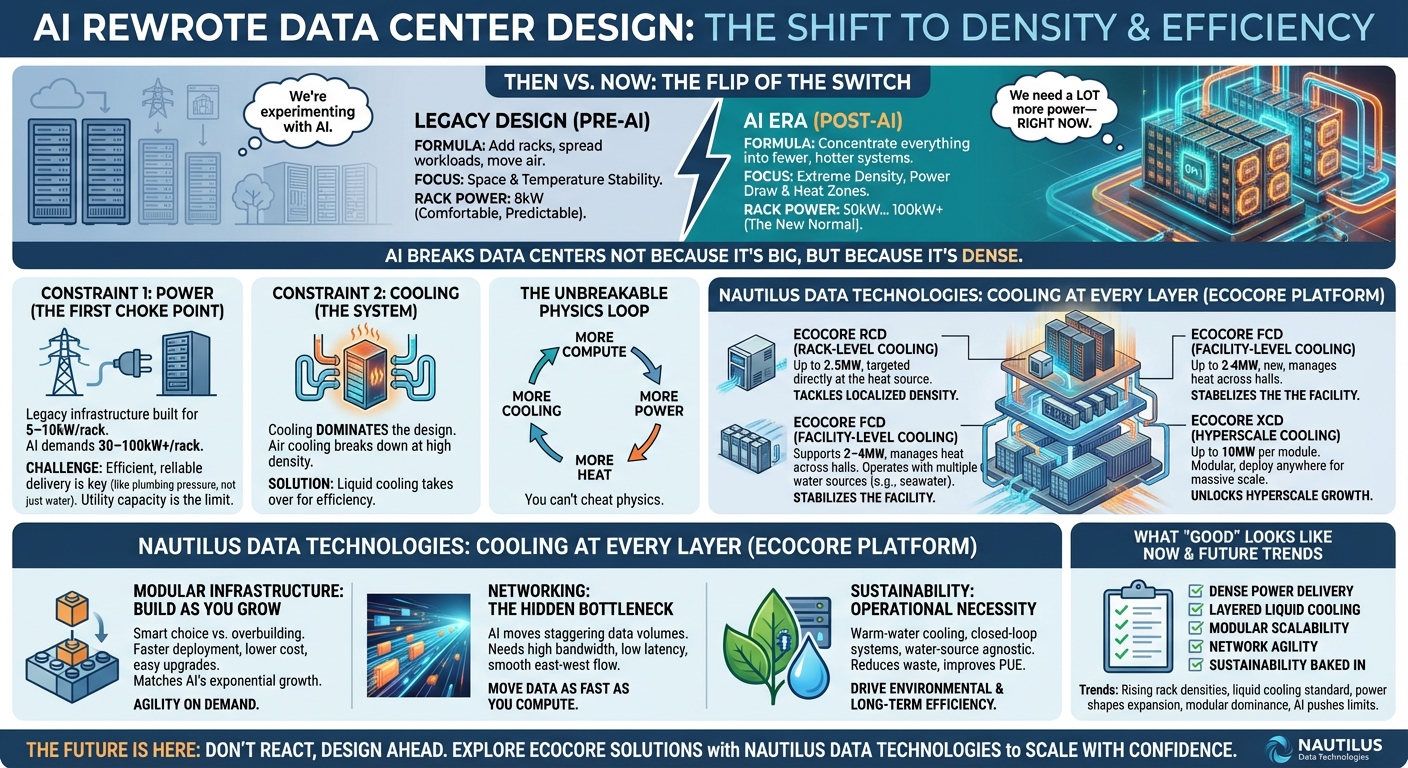
TL;DR – AI workloads have fundamentally changed data center design—what matters now isn’t size, it’s density. Modern infrastructure must deliver high power, advanced (often liquid) cooling, and modular scalability to support racks ranging from 30–100+ kW.
How AI Rewrote Data Center Design
Just a few years ago, we remembered a client proudly showing off their 8 kW racks. Back then, that felt solid and predictable.
Now? We’re casually talking about 50 kW racks… 100 kW racks… and honestly, no one blinks.
That shift didn’t just tweak strategy. It completely rewrote the rules of Data Center Infrastructure Design.
And here’s the part most people miss:
AI doesn’t break your data center because it’s big.
It breaks it because it’s dense.
AI Workloads Quietly Changed the Rules
For years, scaling a data center followed the same formula: add racks, spread workloads, move more air, and keep temperatures steady.
Then AI showed up and flipped that formula on its head: “Let’s concentrate everything into fewer, hotter, power-hungry systems.”
Suddenly, we’re dealing with GPU-heavy clusters, massive per-rack power draw, concentrated heat zones, and cooling systems pushed to their limits.
It wasn’t a slow evolution; it was like flipping a switch.
Why Power Became the First Constraint
Everyone talks about cooling. And yes, it matters a lot. But power? Power is the real constraint.
If you can’t deliver power to the rack, nothing else matters.
Here’s what’s happening in real time:
Legacy infrastructure was built for 5–10 kW racks. AI now demands 30–100 kW+ per rack. Utility capacity becomes the chokepoint, and distribution becomes more complex than generation.
It’s no longer just about having megawatts available. It’s about delivering that energy efficiently, reliably, and exactly where it’s needed. Think of it like plumbing; you don’t just need water, you need pressure, direction, and control.
Cooling Isn’t a System Anymore. It Is the System
Once you cross into AI-scale density, cooling dominates the entire design conversation.
Air cooling still has its role, but it starts to break down as density increases.
That’s why data center liquid cooling is taking over and fast.
The Rise of Liquid Cooling (And Why It Works)
Liquid cooling isn’t new; it’s just finally necessary.
Why? Because liquid transfers heat far more efficiently than air.
Modern AI data centers don’t depend on a single cooling method; they layer solutions.
That’s exactly where Nautilus Data Technologies’ EcoCore platform comes into focus.
Cooling at Every Layer: Rack, Row, and Facility
Rack-Level Cooling
- EcoCore RCD delivers targeted cooling directly at the heat source. It provides up to 2.5 MW of capacity in a compact footprint, making it ideal for retrofits or high-density clusters. You’re not cooling the whole room, you’re cooling the problem.
Facility-Level Cooling
- EcoCore FCD manages heat across entire halls or facilities. Each module supports 2–4 MW and can operate with multiple water sources, even seawater. This becomes the backbone that stabilizes the environment.
Hyperscale Cooling
- EcoCore XCD redefines what it means to scale. Each containerized, modular system delivers up to 10 MW per module, ready to deploy anywhere your mission takes you. It’s the solution for teams that aren’t just scaling, they’re accelerating.
Why Layered Cooling Matters
You don’t choose one strategy; you combine them.- RCD tackles localized density
- FCD stabilizes the facility
- XCD unlocks hyperscale growth
The Physics You Can’t Ignore
You can’t cheat physics.
More computing means more power.
More power means more heat.
More heat means more cooling.
That’s the unbreakable loop.
If you’ve ever stood behind a rack and felt that blast of heat, imagine hundreds of those, constantly.
That’s what AI infrastructure feels like.
Designing for Density (Not Just Growth)
The old way to scale was simple: add more racks and rooms. The new reality focuses on density rather than space.
That changes everything, from rack layouts and cooling zones to power distribution and infrastructure planning.
Modern AI data centers prioritize zoned, high-density clusters, shorter power paths, integrated liquid-cooling loops, and modular expansion.
It’s less like building a warehouse and more like engineering a high-performance engine designed for nonstop acceleration.
Modular Infrastructure: Build as You Grow
Would you rather overbuild and hope demand arrives, or scale exactly when needed?
The smart choice is modularity.
Modular systems mean faster deployment, lower upfront cost, easier upgrades, and scalability that matches AI’s exponential growth. EcoCore systems are designed for this very thing: agility on demand.
Networking: The Hidden Bottleneck
AI workloads move staggering volumes of data. If your network can’t keep pace, your entire operation stalls.
Modern AI-ready networks are defined not just by speed but by efficiency, high bandwidth, low latency, smooth east-west data flow, and scalable backbone architecture.
You can’t just compute fast; you have to move data just as fast.
Sustainability Isn’t Optional
AI’s appetite for power is enormous, making sustainability an operational necessity, not a marketing slogan.
Modern data centers lead the way with warm-water cooling, closed-loop systems, and water-source agnostic designs that reduce waste and improve PUE.
These innovations drive both environmental sustainability and long-term efficiency.
Common Pitfalls in AI Data Center Design
Many operators stumble over the same issues: designing for current loads rather than future density, treating liquid cooling as a luxury, underestimating the complexity of power distribution, or skipping modular frameworks.
Another common oversight: failing to align cooling strategy with workload type.
If any of that sounds familiar, you’re not alone—but now’s the time to adapt before those small issues become major constraints.
What “Good” Looks Like Now
A modern AI-ready data center blends dense power delivery, layered liquid cooling, modular scalability, and network agility, with sustainability baked in from the start.
But more importantly, it’s flexible.
The strongest operators aren’t simply managing infrastructure—they’re treating it like a product: predictable capacity, clear upgrade paths, measurable performance, and adaptive growth.
The Big Shift and Where It’s Headed
Look ahead, and the trends are clear:- Rack densities will continue to rise
- Liquid cooling will become standard
- Power availability will shape expansion
- Modular systems will dominate
- AI workloads will keep pushing physical limits
Final Thoughts
The future of AI infrastructure isn’t coming; it’s already here. And the organizations that win won’t be the ones reacting to constraints, but the ones designing ahead of them.
If you’re planning your next phase of growth, now is the time to rethink how power, cooling, and scalability work together. The right infrastructure doesn’t just support AI, it enables it.
Ready to design for what’s next? Connect with Nautilus Data Technologies to explore how EcoCore solutions can help you scale with confidence.
FAQs
What is the biggest challenge in AI data center infrastructure design?
The biggest challenge is managing power and heat density. AI workloads concentrate massive compute into fewer systems, which increases power demand and generates intense heat in small areas. This requires advanced power distribution and liquid cooling strategies to maintain performance and reliability.
Why is liquid cooling becoming essential for AI data centers?
Liquid cooling is essential because it removes heat far more efficiently than air. As rack densities reach 30–100 kW or more, traditional air cooling struggles to keep up, while liquid cooling can handle high heat loads directly at the source.
How does modular infrastructure improve AI data center scalability?
Modular infrastructure allows operators to scale incrementally instead of overbuilding. Systems like containerized cooling and power modules can be deployed as demand grows, reducing upfront costs and enabling faster expansion aligned with AI workload needs.
What role does power play in AI-ready data centers?
Power is the primary constraint in AI data centers. It’s not just about having enough capacity; it’s about delivering power efficiently to high-density racks. Without proper power distribution, even the best cooling systems cannot compensate.
What does a modern AI-ready data center look like?
A modern AI-ready data center combines high-density power delivery, layered liquid cooling (rack, row, and facility level), modular scalability, and high-performance networking. It is designed for flexibility, allowing operators to adapt quickly as AI demands evolve.

