
What Is a Coolant Distribution Unit (CDU)?
So, what is a CDU—really?
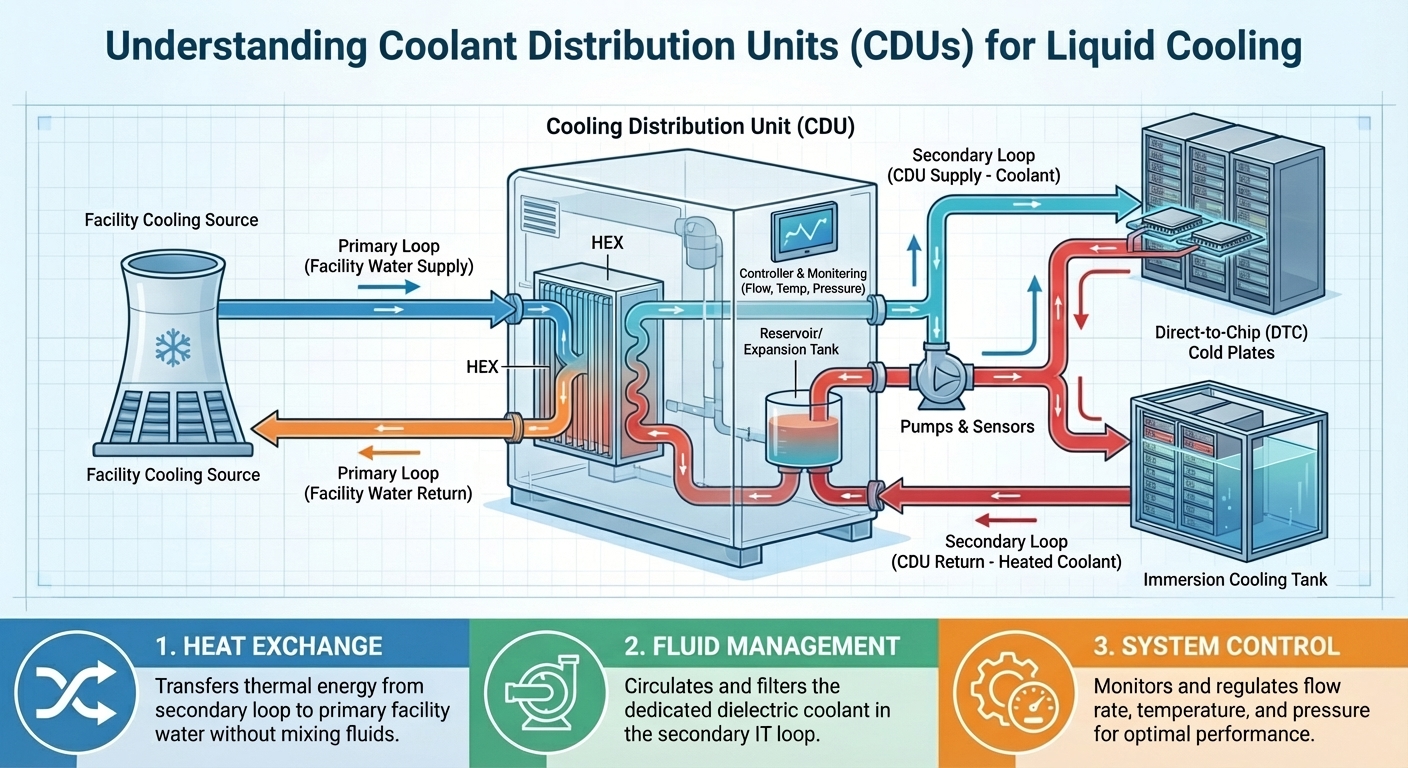
A coolant distribution unit moves cooling liquid from the facility’s supply to the servers and back. It keeps the system stable, controlled, and safe.
Think of it like this:
- The building provides cooling capacity
- The servers need cooling delivered precisely
- The CDU connects the two
Along the way, it controls temperature, pressure, and flow rates. It also keeps the liquid circulating near IT equipment separate from the facility’s main water system. That separation reduces risk and protects sensitive hardware.
Most facilities place CDUs near the racks they serve. They are either in-row or next to the racks. This setup allows for quicker responses to workload changes. It also helps remove heat efficiently when demand increases.
Why Liquid Is Better at Transferring Heat
Have you ever noticed how quickly water cools something compared to air?
That’s not a coincidence.
Liquid can carry far more heat than air per unit volume and dissipate it more quickly from components such as CPUs and GPUs. This makes it ideal for modern servers that use cold-plate designs to extract heat directly from the source.
In practical terms, this means:
- Less energy wasted moving air
- Smaller cooling footprints
- Better control of hot spots
As AI models get bigger and power densities increase, this trend became stronger through 2025. The efficiency gap between air and liquid cooling is now hard to ignore. Without a CDU, much of that advantage disappears.
How Do CDU Units Work?
Let’s walk through it step by step.
A CDU makes a controlled liquid loop. This loop connects the cooling system to the servers. It keeps the two fluids from mixing directly.
Inside a typical CDU, you’ll find:
- Pumps that regulate flow rates
- Heat exchangers that remove absorbed heat
- Sensors monitoring temperature and pressure
- Controls that adjust operation in real time
Here’s what happens during normal operation:
- Cool liquid enters the CDU
- The CDU delivers it to servers
- The liquid absorbs heat from cold plates
- Warm liquid returns to the CDU
- Heat is removed, and the cycle repeats
This continuous loop adapts as workloads rise and fall, ensuring reliable performance even during sudden demand spikes.
Liquid-to-Liquid CDUs
Liquid-to-liquid CDUs are the most common choice for high-density deployments.
They transfer heat from the server cooling loop to another liquid system, typically chilled water from the facility. This design supports high cooling capacity and precise control, making it ideal for:
- AI training clusters
- High-performance computing
- Dense GPU environments
These CDUs work well with facility infrastructure. They work best for data centers that builders design for a specific purpose or that upgrades significantly enhance.
Liquid-to-Air CDUs
Liquid-to-air CDUs take a different approach.
Instead of relying on facility water, they reject heat into the surrounding air. This makes them easier to deploy where plumbing changes are limited.
They are commonly used for:
- Smaller liquid cooling deployments
- Pilot programs
- Fast retrofits
Their capacity is lower than that of liquid-to-liquid systems. However, they provide a practical way to start using liquid cooling.
Benefits of a Coolant Distribution Unit
Why are CDUs becoming standard equipment?
Because they deliver measurable results.
- Improved energy efficiency by cooling only where heat is generated
- Better thermal control during workload spikes
- Higher reliability through monitoring and redundancy
- Scalable deployment, rack by rack
- Lower long-term operating costs
Most importantly, CDUs support future growth. As compute density continues to rise, they provide a clear and flexible path forward for liquid-cooled infrastructure.

Where Do You Go From Here?
Liquid cooling is no longer a fringe technology. Today, it is a core strategy for supporting AI-driven growth in modern data centers.
And CDUs? They are the base that makes liquid cooling practical, scalable, and safe. They also ensure efficient heat removal and long-term reliability.
If you are planning new deployments, upgrading existing facilities, or preparing for higher-density workloads, CDUs deserve serious consideration.
So here’s the real question:
How is your data center preparing for the next wave of heat?
Why the Nautilus EcoCore CDU
As liquid cooling adoption has gained traction through 2024 and 2025, data center operators now prioritize reliability, risk reduction, and scalability alongside performance.
Nautilus Data Technologies designed the EcoCore CDU for high-density computing. It works well with AI and GPU-heavy tasks that create constant, uneven heat. The system maintains stable temperature and flow without constant manual tuning.
A key differentiator is its patented leak prevention design. EcoCore does not just wait for failures to find leaks.
Instead, it works to prevent leaks at key points. This approach lowers operational risks. It also boosts confidence when using liquid cooling near important IT equipment.
EcoCore is also built for scalability. It integrates with existing facility cooling systems and supports incremental expansion as rack densities increase. Delivering cooling directly where heat generates improves efficiency and reduces reliance on energy-intensive air cooling.
For data centers planning long-term growth, EcoCore offers a CDU platform aligned with modern liquid-cooling requirements.
For data centers planning long-term growth, EcoCore offers a CDU platform aligned with modern liquid-cooling requirements. Connect with our team to see how it can support your next deployment.


